How much straw pellet bedding does one horse need per year?

The question we get most often from stable managers planning next season. Here are the numbers we and our customers work with. Initial fill Reckon with about 11.5 kg of pellets per…

The question we get most often from stable managers planning next season. Here are the numbers we and our customers work with.

Initial fill

Reckon with about 11.5 kg of pellets per square metre for a 5 cm layer. A 10 m² box therefore needs roughly 120 kg – 8 bags of 15 kg or 7–8 bags of 16 kg. A 12 m² box needs around 140 kg.

Weekly top-up

Once the bed is established, most horses need 15–30 kg per week (1–2 bags), depending on how long the horse stays inside, how wet it is and how thoroughly the box is mucked out. Horses that are out all day sit at the low end.

Per year

Initial fill plus 52 weeks of top-ups gives roughly 900–1,600 kg per horse per year. In practice one pallet of about 1,000 kg is the common planning figure for one horse, with a second pallet for horses kept inside a lot.

For a whole stable

A 20-horse yard therefore uses around 20–30 tonnes a year – which is exactly one full truckload from us (24 t), delivered to your door at producer prices. Larger yards order two or three loads spread over the season.

What reduces consumption

  • Remove only droppings and the wet spot, leave the clean bedding in place
  • Rubber mats under the bed
  • Watering the pellets properly at set-up so they open fully

Want us to calculate your stable? Send us the number of horses and box sizes and we quote a delivered price per truckload.
Bedding pellets vs. heating pellets: why the difference matters for your horse

Straw pellets look alike in the bag. They are not alike in the box. A large share of the “bedding pellets” offered to stables are in fact heating pellets – pressed hard for boilers…

Straw pellets look alike in the bag. They are not alike in the box. A large share of the “bedding pellets” offered to stables are in fact heating pellets – pressed hard for boilers, not for horses. Here is how to tell them apart and why it matters.

What a heating pellet is made for

Heating pellets are pressed as dense as possible so they burn evenly. The raw material is not screened for dust, and nobody cares whether they open up when wet. In a box they stay hard, absorb slowly and turn into a dusty, uneven layer.

What a bedding pellet is made for

A bedding pellet is ground to an open structure, screened with sieves, magnets and filters, and pressed at +85…+110 °C so that mould spores and bacteria are killed. Watered, it breaks into a soft, absorbent layer that holds roughly three times its own weight and binds ammonia.

How to check

  • Ask what the pellet was produced for. A producer of bedding will show you the process, not just the price.
  • Water a handful. Bedding pellets open into fluffy fibre within an hour; heating pellets stay hard or turn into mush.
  • Look at the dust at the bottom of the bag. Screened bedding pellets leave almost none.
  • Watch the price. Saving 10–20 euros per tonne on a heating pellet is quickly lost in higher consumption – and in a coughing horse.

We make both – and we label them

BaltPellet produces bedding pellets and heating pellets in separate lines. You always know which one you are buying, and we will never sell you the one for the other. See our products or ask for a sample.

Less manure, faster compost: the hidden saving of pellet bedding

When stables compare beddings they usually look at the price per bag. The bigger difference is often at the other end of the stable – the manure heap. Why the heap shrinks With str…

When stables compare beddings they usually look at the price per bag. The bigger difference is often at the other end of the stable – the manure heap.

Why the heap shrinks

With straw pellets only the wet spot and droppings leave the box. The clean bedding stays. Compared with loose straw or shavings, the volume that goes onto the heap each day is a fraction – which means fewer container changes, fewer tractor hours and less space.

Why it composts faster

Straw pellets are pure, finely structured plant fibre with no resins. Mixed with manure they heat up quickly and break down into usable compost within months, whereas shavings can take a year or more and can lock up nitrogen in the soil.

Where the manure goes

Farmers and biogas plants generally prefer straw-based horse manure over shavings-based manure. In several of our markets stables that switched to pellets found it easier – and sometimes cheaper – to get rid of the manure.

Same benefits for other animals

The same pellets are used as bedding for cattle, poultry and small animals, where the low volume of used bedding and fast composting are just as valuable.

Straw pellets from BaltPellet are produced in our own factories in Latvia and Lithuania and delivered by the full truckload across Scandinavia. See our products.

Straw pellets vs. shavings: what actually changes in the stable

Many stables that switch from shavings to straw pellets tell us the same things after the first month. Here is what to expect. Absorption and dry boxes Pellets soak up several time…

Many stables that switch from shavings to straw pellets tell us the same things after the first month. Here is what to expect.

Absorption and dry boxes

Pellets soak up several times their own weight in liquid and hold it in the wet spot, whereas shavings spread moisture across the bed. The result is a drier surface, less ammonia smell and a horse that comes out cleaner in the morning.

Less material, less time

Because only the wet spot and droppings are removed, the clean bedding stays in the box. Daily mucking out typically takes less time, and weekly top-ups are a bag or two rather than a wheelbarrow of shavings.

The manure heap

This is the part stable owners notice most. Pellet bedding produces a smaller, denser heap that composts in a fraction of the time shavings need. Farms and manure contractors accept it more readily – and some pay for it.

Storage and handling

A pallet of 15 or 16 kg bags takes very little space compared to bales of shavings for the same number of bedding-weeks. Big bags of 500 or 1000 kg suit larger yards with a loader.

Dust

Straw pellets are pressed and screened, so fines are removed before bagging. Once watered, the bed is practically dust-free.

What to watch

The first set-up of a box needs more bags than a weekly top-up – plan for 8–10 bags per box. And pellets must be watered to open up; a bed of dry, whole pellets is not what you want under a horse.

Curious how the numbers work for your stable? Contact us – we are happy to calculate a season’s need and quote a delivered price per truckload.
How to bed a horse box with straw pellets – step by step

Straw pellets are one of the easiest beddings to manage once the box is set up correctly. Here is how our customers across Sweden, Finland, Norway and Denmark do it. 1. Start with …

Straw pellets are one of the easiest beddings to manage once the box is set up correctly. Here is how our customers across Sweden, Finland, Norway and Denmark do it.

1. Start with a clean, dry box

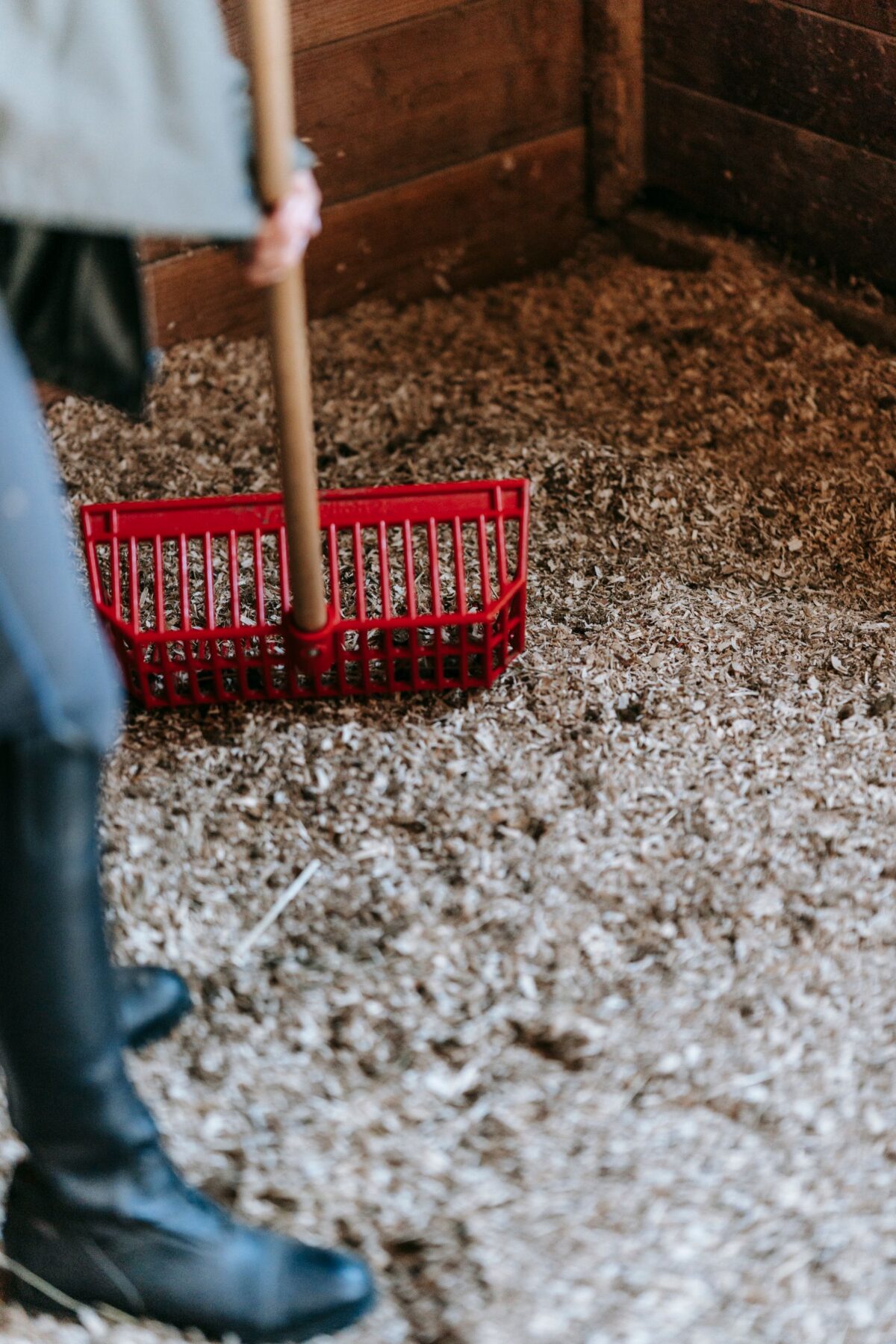
Muck out completely and let the floor dry. Rubber mats are a bonus but not required – pellets work on concrete, asphalt and mats alike.

2. Spread 8–10 bags

For a standard box (about 3 × 3.5 m) spread 8–10 bags of 15–16 kg evenly over the floor. Big-bag users need roughly 120–150 kg.

3. Water the pellets

Sprinkle water over the pellets with a hose or watering can – around 5–10 litres per bag. Within an hour the pellets swell and break into a soft, fluffy layer. Some stables leave part of the bed as whole pellets, which then open up naturally as they absorb moisture.

4. Daily care

Remove droppings and the wet spot each day. Because pellets absorb quickly and lock the moisture in, the wet area stays small and the rest of the bed remains clean and dry.

5. Top up weekly

Add 1–2 bags a week depending on the horse and how much time it spends in the box. Most stables report using clearly less material than with shavings.

Good to know

  • Straw pellets are low in dust and suitable for horses with sensitive airways.
  • Used bedding composts fast and produces a much smaller manure heap.
  • Our pellets are 100% cereal straw – no binders, no additives.

Need bedding for a whole stable? We deliver full truckloads (about 24 t) straight from our factories in Latvia and Lithuania. Request a quote.